The ground beneath Peterborough tells two completely different stories depending on where you stand. North of the Nene, we encounter stiff Oxford Clay that holds slopes remarkably well but demands careful attention to shrinkage potential during dry summers. South of the river, the river terrace gravels and soft alluvium create a completely different picture — high permeability, variable bearing capacity, and a water table that sits barely a metre below ground level in some pockets. Having processed samples from both sides of the city for over a decade, our lab team knows exactly which index tests trigger which design decisions. A test pit campaign near the Embankment reveals the transition zone where gravel lenses pinch out against weathered clay, and that boundary matters enormously for differential settlement calculations on mixed-use developments going up along the parkways.
The overconsolidation ratio in weathered Oxford Clay across Peterborough regularly surprises engineers who assume normally consolidated behaviour at foundation level.
Our approach and scope
Site-specific factors
BS 5930:2015+A1:2020 sets out clear investigation density requirements, but Peterborough's geological patchwork makes generic desk study assumptions actively dangerous. The Cornbrash limestone outcrops in the western parishes sit directly over Lias Clay at shallow depth, and a borehole terminating two metres too early misses the transition entirely. We have seen foundation designs proceed on assumed competent rock only to discover weathered, compressible material at bearing level when additional investigation is commissioned. Eurocode 7 (BS EN 1997-2:2007) requires derived values to be assessed against comparable knowledge, and in this city that means understanding the difference between undisturbed block samples and rotary core recovery in the same formation. Groundwater monitoring over a full seasonal cycle is not optional here — the May-to-October fluctuation in the Nene floodplain gravels regularly exceeds 1.2 metres, and effective stress calculations without that data are guesswork.
Regulatory framework
BS 5930:2015+A1:2020 Code of practice for ground investigations, BS EN 1997-2:2007 Eurocode 7 — Geotechnical design — Part 2, BS 1377-2:2022 Methods of test for soils — Classification tests, BS EN ISO 17892-9:2018 Triaxial compression tests, BRE Special Digest 1 (SD1) — Concrete in aggressive ground
Linked services
Classification and index testing suite
Full BS 1377-2 classification including Atterberg limits, particle size distribution by wet sieving and sedimentation, moisture content, bulk and dry density, and organic content determination. We process high-plasticity Oxford Clay samples within 48 hours of extraction to preserve natural moisture condition.
Strength and compressibility testing
Triaxial compression (CIU and CAU) under BS EN ISO 17892-9, unconfined compressive strength for cohesive strata, and oedometer consolidation testing at incremental loads up to 800 kPa. Effective stress parameters are reported with stress path plots for critical state interpretation.
Chemical aggressivity assessment
BRE SD1 suite covering water-soluble sulphate, pH, total sulphur, and chloride content. Peterborough's Lias Clay and occasional pyritic bands in the Oxford Clay make sulphate testing mandatory for buried concrete specification per BS 8500-1.
Typical parameters
Q&A
What does a soil mechanics study in Peterborough typically cost?
For a combined field investigation and laboratory testing programme on a standard residential plot in Peterborough, budgets range from £2.130 to £4.030 depending on borehole depth, number of samples, and the testing schedule required. A site with deep Oxford Clay requiring triaxial and consolidation testing will sit at the upper end, while a straightforward gravel-over-clay profile with classification-only testing comes in lower.
How long does laboratory testing take once samples arrive?
Classification tests (moisture content, Atterberg limits, particle size distribution) are typically reported within five working days. Consolidation and triaxial testing require longer — oedometer tests run seven to ten days per sample due to incremental loading stages, and CIU triaxial with pore pressure measurement adds another week. We schedule testing to align with your design programme deadlines.
Which BS standards apply to soil testing for Peterborough projects?
BS 5930:2015+A1:2020 governs the ground investigation framework, BS 1377 covers laboratory test methods across all parts, and BS EN 1997-2 provides the Eurocode 7 requirements for deriving geotechnical design parameters. For concrete specification in sulphate-bearing ground, BRE SD1 and BS 8500-1 apply.
Do you handle the site investigation fieldwork or just the lab testing?
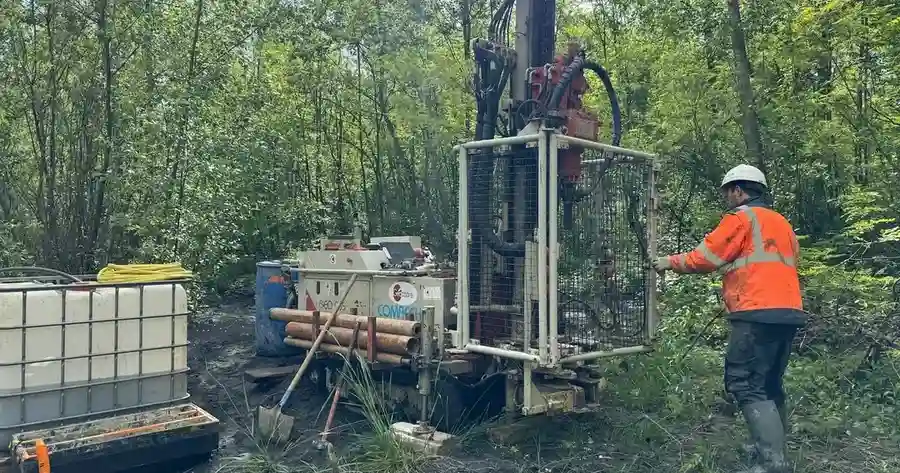
We coordinate the full chain — our team manages the borehole drilling, trial pitting, and in-situ sampling across Peterborough, then transfers samples directly to our laboratory under chain-of-custody protocols. This eliminates the delay and sample degradation that occurs when different contractors handle field and lab phases separately.