The application of Eurocode 7, specifically BS EN 1997-2:2007, drives our approach to ground investigation in Peterborough. The city straddles a complex boundary between the Jurassic Oxford Clay formation to the west and the softer, compressible Quaternary deposits of the Fenland basin to the east, creating a geotechnical patchwork that demands high-resolution subsurface data. A standard window sampler borehole simply cannot capture the thin sand lenses and interbedded peat layers that frequently govern settlement behaviour here. By deploying our 20-tonne CPT rig, we produce a near-continuous profile of cone resistance and sleeve friction, allowing the engineering team to model the transition from the stiff clay till into the underlying variable Lias Group without the sample disturbance that plagues traditional drilling in saturated ground. This approach is often paired with laboratory triaxial testing on recovered samples from adjacent boreholes to calibrate the undrained shear strength parameters derived from the cone data, ensuring the geotechnical model reflects the true material response of the local geology.
A CPT profile in Peterborough reveals the geological story that a standard borehole log misses: the thin, discontinuous silt partings within the Oxford Clay that control drainage and consolidation rate.
Our approach and scope
Site-specific factors
Peterborough’s post-war expansion pushed residential and industrial development eastwards onto the peat and soft alluvial clays of the Fens, a landscape that had been actively drained and settled for centuries. This progressive urban creep onto highly compressible ground means many sites now slated for redevelopment conceal buried channels of organic silt or lenses of fibrous peat that are entirely invisible from the surface. A conventional investigation with widely spaced trial pits could easily straddle such a feature and report a uniform, competent clay profile. The CPT eliminates this spatial risk by providing a continuous, high-density data record at a fraction of the time needed for a cable-tool borehole. More critically, the measurement of excess pore pressure during penetration gives an immediate indication of a soil’s drainage state; a slow dissipation curve in the Fen silts flags the precise condition that leads to long-term consolidation settlement under even modest foundation loads, a scenario we have encountered repeatedly when reviewing older buildings in the Eastfield and Fengate areas.
Regulatory framework
BS EN 1997-2:2007 (Eurocode 7 – Ground investigation and testing), BS 5930:2015+A1:2020 (Code of practice for ground investigations), BS EN ISO 22476-1:2012 (Geotechnical investigation and testing – Field testing – Part 1: Electrical cone and piezocone penetration test)
Linked services
Seismic CPT (SCPTu) for Foundation Design
We combine the standard piezocone with a triaxial geophone array to measure downhole shear wave velocity (Vs) at 1-metre intervals. This is particularly relevant on the western side of Peterborough, where the maximum depth of the Oxford Clay weathering profile must be established for mat foundation design. The Vs profile feeds directly into site-specific ground response analysis and small-strain stiffness modelling, removing the conservatism inherent in correlations based solely on qc.
CPT with Continuous Soil Sampling
For projects in the Fen-edge zone where the stratigraphy includes peat, soft clay, and potential archaeological layers, we deploy a Mostap sampling system directly behind the CPT cone. This allows retrieval of a near-undisturbed 50 mm diameter liner sample at any depth without removing the rods, providing material for Atterberg limits testing and organic content determination. The sample tube is sealed against the borehole wall, preserving the in-situ moisture content and fabric of these sensitive, low-strength deposits.
Typical parameters
Q&A
How much does a CPT test cost in Peterborough?
For a standard CPT sounding in the Peterborough area, the cost typically ranges from £130 to £210 per metre of penetration, depending on the total depth of the programme, the need for a piezocone versus a mechanical cone, and the specific access conditions on site. A full day of CPT work with a tracked rig, including mobilisation and demobilisation within the PE postcode area, usually falls between £1,800 and £2,600. The final figure is influenced by the presence of made ground or obstructions that require pre-drilling, and whether additional modules like the seismic geophone or dissipation tests are specified.
What is the difference between CPT and a standard SPT borehole?
The fundamental difference lies in the continuity and nature of the data. A Standard Penetration Test (SPT) records the number of blows required to drive a split-spoon sampler 300 mm into the soil at discrete 1.5-metre intervals, providing a disturbed sample and a single N-value per test. The CPT pushes an instrumented cone continuously into the ground, measuring tip resistance, sleeve friction, and pore pressure every 10 mm, producing a virtually uninterrupted profile of soil behaviour without generating spoil or disturbing the material. In Peterborough’s interbedded Fen deposits, the CPT detects thin sand layers and peat pockets that an SPT would completely miss between test intervals, and it does so in a fraction of the time, with a typical 20-metre sounding completed in under two hours.
Can CPT testing be carried out on small or restricted-access sites in Peterborough?
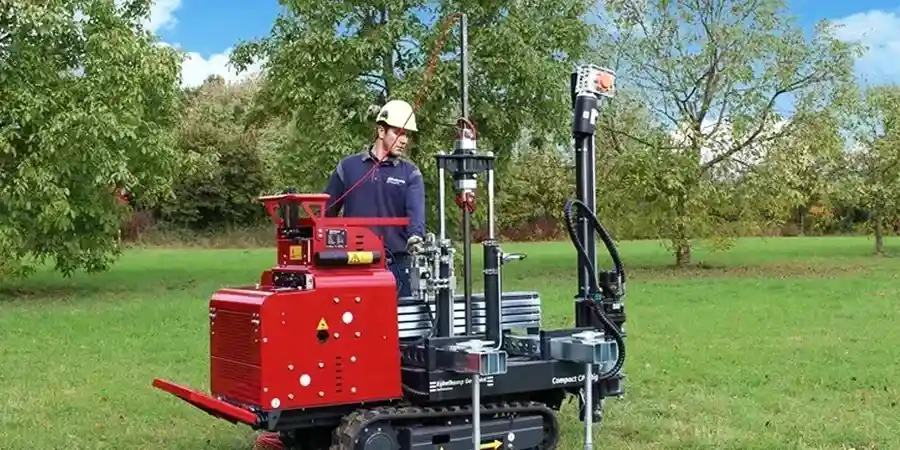
Yes, restricted-access CPT is a common requirement on the tight urban plots around the city centre and the Victorian terraces of Millfield and New England. We operate a range of rigs, including a compact, narrow-track machine with a 1.2-metre width that can pass through a standard side gate, and a truck-mounted unit for open sites on the outskirts. Where overhead clearance is limited, the push rods can be handled in 1-metre sections. The critical limiting factor is the push reaction force: the rig’s weight must exceed the required penetration force, so in very confined spaces with soft ground at the surface, we use screw anchors or ground anchors to offer the necessary reaction, a technique we have applied successfully on riverbank sites along the Nene.