The plate bearing test rig—a hydraulic jack braced against a heavy reaction frame—is often the first piece of equipment we mobilise to a Peterborough site. The city’s geology shifts abruptly from stiff, fissured Oxford Clay in the west to Nene Valley sands and gravels near the embankment, and a uniform foundation approach simply does not work here. We run the test in at least three locations per plot, logging pressure-settlement curves until the ground yields or we hit 2.5 times the design load. Those numbers feed directly into the bearing capacity model, and where the clay is softened by the high water table typical of the Fens margin, we supplement the plate data with a CPT test to map the depth of the weathered crust before finalising the shallow foundation design.
Effective stress parameters measured on undisturbed Peterborough clay samples typically yield drained friction angles between 22° and 26°, with cohesion intercepts under 5 kPa once the fissures open under load.
Our approach and scope
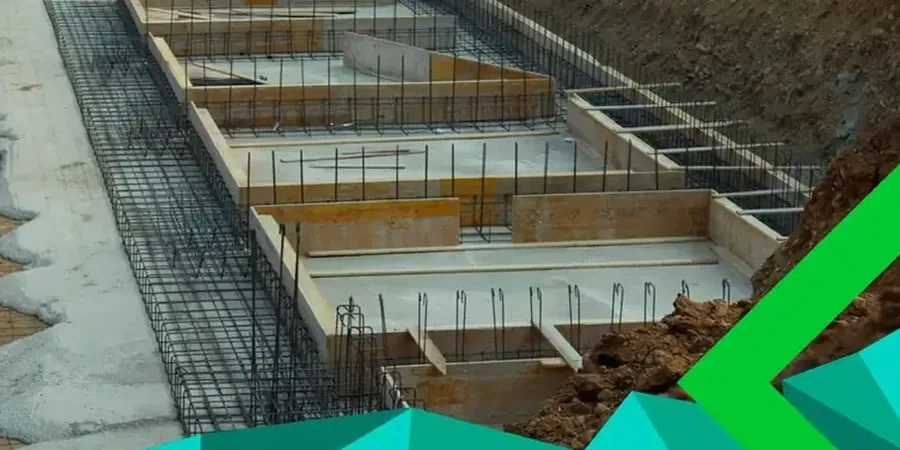
Site-specific factors
Peterborough’s post-war expansion pushed housing onto the Lower Oxford Clay slopes west of the city centre, and the 2021 UK Climate Projections (UKCP18) indicate a 20 % increase in winter rainfall intensity by 2050 for the East of England. For shallow foundations that means two things: prolonged saturation softening the clay to its fully softened strength, and a rising water table that erodes the bearing stratum. We model both stages—short-term undrained during construction, long-term drained with the highest credible groundwater level—using the partial factors from BS EN 1997-1 Annex A. Where the factor of safety on bearing drops below 2.0 under the drained scenario, we adjust the footing geometry or recommend a stone column treatment beneath the pad to create a drained load path through the softened zone.
Regulatory framework
BS EN 1997-1:2004 Eurocode 7 – Geotechnical design – Part 1: General rules, BS EN 1997-2:2007 Eurocode 7 – Ground investigation and testing, BS 5930:2015 Code of practice for ground investigations, BS 8004:2015 Code of practice for foundations, BS 1377-9:1990 Methods of test for soils – In-situ tests (plate bearing)
Linked services
Bearing capacity and settlement analysis
Analytical calculation using the Brinch Hansen method with depth and shape factors calibrated to the actual footing geometry, checked against a finite element settlement model when layered ground or eccentric loading is present.
Ground investigation for foundation design
Cable percussive boreholes with SPT every 1.0 m, U100 sampling of the bearing stratum, standpipe piezometers to monitor seasonal water level fluctuation, and laboratory classification to BS 1377.
Construction verification testing
Post-excavation plate load tests on the formation level, density checks on granular replacement layers using the sand cone method, and hand shear vane tests to confirm the undrained strength of the exposed clay surface before blinding concrete is placed.
Typical parameters
Q&A
What ground investigation data is needed before starting a shallow foundation design for a Peterborough plot?
We need at least one borehole or deep trial pit per 250 m² of building footprint, penetrating to a depth of 1.5 times the footing width below the proposed bearing level. In Peterborough’s clay areas that typically means 3.0–4.0 m depth, with U100 samples recovered from the bearing stratum for triaxial and oedometer testing. If the site is within 200 m of the Nene floodplain, a standpipe piezometer should be installed and read over a minimum of three months to capture the seasonal high water table.
How much does a shallow foundation design package cost for a typical residential project in Peterborough?
For a single dwelling on a standard Peterborough plot, the combined ground investigation and foundation design report ranges from £1.350 to £2.120 excluding VAT. The final figure depends on access conditions, the number of boreholes required, and whether the site is on the shrinkable clay belt where deeper sampling and swelling pressure tests are necessary.
Do you use presumptive bearing values from BS 8004 or site-specific testing?
We never rely solely on presumptive values for final design. BS 8004 Table 1 gives a useful starting range, but the Oxford Clay in Peterborough varies enough—particularly where it transitions from the weathered brown zone to the unweathered grey material—that site-specific plate tests or triaxial data are essential to justify the bearing pressure. The building control officer for Peterborough City Council will typically ask for the test data rather than accepting a presumptive figure.
What happens if the shallow foundation design shows excessive settlement on the Fen-edge silts?
When the settlement calculation exceeds the 25 mm allowable under BS EN 1997, we have two main options. The first is to widen the footing to reduce the bearing pressure and spread the load over a larger area. The second, used on several projects near the Flag Fen basin, is to excavate the compressible silt and replace it with a compacted granular fill layer, verified by sand cone density testing at 250 mm lifts. If the soft layer is thicker than 1.5 m, we evaluate vibro stone columns as a ground improvement alternative before moving to a deep foundation solution.