Peterborough’s expansion from a medieval market town into a rapid-growth city has placed immense pressure on its underlying geology, turning retaining wall design into a recurrent necessity rather than an occasional afterthought. The city sits squarely on the Jurassic Oxford Clay Formation, mantled in the Nene Valley by Quaternary river terrace gravels and pockets of alluvium, a sequence that produces abrupt transitions between stiff overconsolidated clay and loose water-bearing granular material within a single excavation face. When a developer cuts into the shallow slope along the A1139 corridor or excavates for a basement near the Cathedral precinct, the retained height must contend with both short-term undrained clay pressures and long-term drained gravel parameters, a dual condition that makes the slope stability assessment inseparable from the wall design itself. We rely on site-specific SI data, sampled and tested to BS 5930 standards, to define the K₀ profile and select a wall typology that performs across Peterborough’s seasonal groundwater fluctuations, which can vary by more than 1.5 m between winter and late summer.
A retaining wall in Peterborough is a hydraulic structure as much as a geotechnical one; drain the gravel or design for the water, there is no middle ground.
Our approach and scope
Site-specific factors
BS EN 1997-1 and its UK National Annex demand that ultimate limit state checks for retaining structures consider both GEO (ground failure) and HYD (heave/piping) limit states, and in Peterborough the HYD case is disproportionately critical because of the Nene gravels’ hydraulic connection to the river. On a site north of the Embankment, where the terrace gravels are 3 to 4 m thick and the river level is tidally influenced, a cantilever wall excavated to formation without a cut-off risks piping beneath the toe during a low-water event, a scenario that EC7’s partial factors do not automatically protect against unless the designer models the exit gradient explicitly. We combine the wall structural check with a flow-net analysis and, where the calculated factor of safety against heave drops below 1.5, we introduce a sheet-pile toe or a grouted base plug detailed in the grouting scope. The risk is not seasonal but event-driven, and a storm surge coinciding with a high river stage can induce a transient hydraulic gradient that exceeds the critical value for the silty fine sand fraction often found at the base of the gravel.
Regulatory framework
BS EN 1997-1:2004 (Eurocode 7: Geotechnical design) with UK National Annex, BS 8002:2015 Code of practice for earth retaining structures, BS 5930:2015+A1:2020 Code of practice for ground investigations, BS EN 1990:2002+A1:2005 Basis of structural design (design life and consequence class), NHBC Standards Chapter 4.2 (for residential basements where applicable)
Linked services
Cantilever and Counterfort Wall Design
Full ULS and SLS verification for reinforced concrete stems, bases, and counterforts using soil parameters derived from triaxial testing on undisturbed Peterborough clay samples. We size the heel and toe for bearing pressures compatible with the logged undrained shear strength, and we detail the reinforcement for crack-width control under long-term flexure.
Embedded Wall Analysis (Sheet Pile and Secant Pile)
For basements and underpasses where excavation depth exceeds 3.5 m, we model the wall as a beam on non-linear Winkler springs, calibrating the p-y curves against SPT and CPT data. The output includes bending moments, shear forces, and required embedment depth, checked against rotational failure and piping where the toe terminates in Nene gravel.
Reinforced Soil and Gravity Wall Solutions
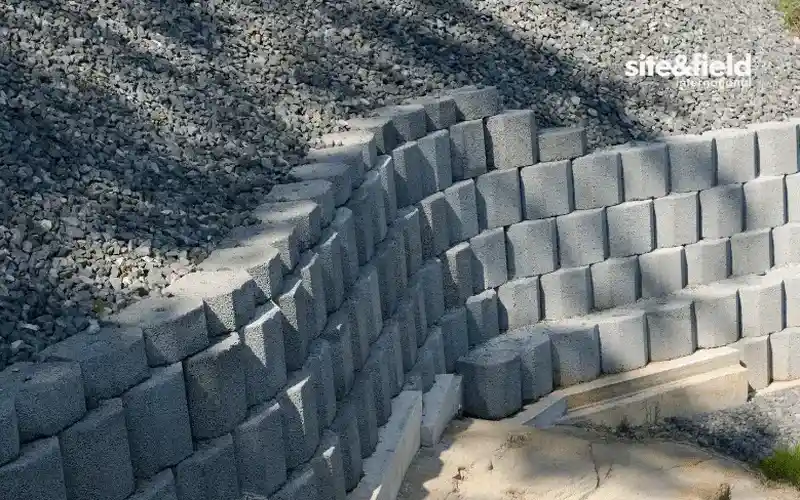
When site access allows, we design MSE walls with geogrid reinforcement lengths tied to the active wedge geometry in the clay fill, or gabion walls for Nene Valley landscape integration. We specify the select backfill gradation and compaction control, referencing the grain size distribution of the proposed borrow material to ensure internal drainage.
Typical parameters
Q&A
How much does a retaining wall design for a Peterborough project typically cost?
The design fee depends on wall height, retained material complexity, and the number of limit states that must be checked. For a typical Peterborough residential or light-commercial wall (retained height 1.2 m to 3.5 m) with one borehole’s worth of ground data, the design package generally falls between £730 and £3,470. Taller walls exceeding 3.5 m, or walls retaining public highways where CD 377 surcharge loading applies, move toward the upper end because they require more detailed FE modelling and a higher consequence-class documentation set.
Which design standard applies to a retaining wall built on Oxford Clay in Peterborough?
The governing standard is BS EN 1997-1:2004 (Eurocode 7 – Geotechnical design) together with the UK National Annex, which prescribes the partial factors for soil parameters and actions. BS 8002:2015 provides complementary recommendations specific to earth retaining structures, including guidance on earth pressures, drainage provisions, and movement limits. For walls adjacent to highways, additional loading from CD 377 may apply, and for residential basements the NHBC Standards Chapter 4.2 often sets the minimum waterproofing and drainage requirements.
What groundwater challenges affect retaining walls in the Nene Valley?
The Nene Valley’s Quaternary river terrace gravels are highly permeable and, across much of Peterborough, are in hydraulic continuity with the River Nene. This means the groundwater level behind a retaining wall can respond within hours to river stage changes. We design the drainage system for the more severe of two conditions: a sustained winter high-water level measured in the standpipe, or a transient storm event that raises the phreatic surface by an additional metre. Without a properly sized drainage blanket or weep-hole array, hydrostatic pressure behind the wall can double the design bending moment.
Do I need a separate slope stability analysis if I am already designing a retaining wall?
Yes, in most Peterborough sites where the retained height exceeds 2 m or where the ground slopes behind the wall crest. The wall design verifies local stability (overturning, sliding, bearing), but it does not automatically check global slope failure on a surface that passes beneath the wall foundation. On Oxford Clay slopes, a deep-seated circular failure through the weathered zone can govern the required embedment depth, so we run a separate limit equilibrium analysis, often coupled with the wall section, to confirm that the overall factor of safety meets the EC7 DA1 combination requirements.