The hydraulic rotary rig sets up on site, its drill head aligning over the first borehole location. In Peterborough, deep excavation design starts with this machine. It recovers continuous cores through the superficial gravels and into the stiff Oxford Clay beneath. The city sits on Jurassic clays overlain by Quaternary river terrace deposits from the Nene. We log every sample at the bench. The recovery ratio tells us about fissuring and weathering grade. From these cores we select specimens for triaxial testing in our UKAS-accredited laboratory. Effective stress parameters are what matter for a braced cut or a secant pile wall. Without them, any temporary works design is guesswork. The rig's mud pump maintains stability through the granular upper layers while we target the competent clay at depth for the formation level.
Fissured Oxford Clay controls the design. Ignore the mass strength reduction and your shoring system will be undersized.
Our approach and scope
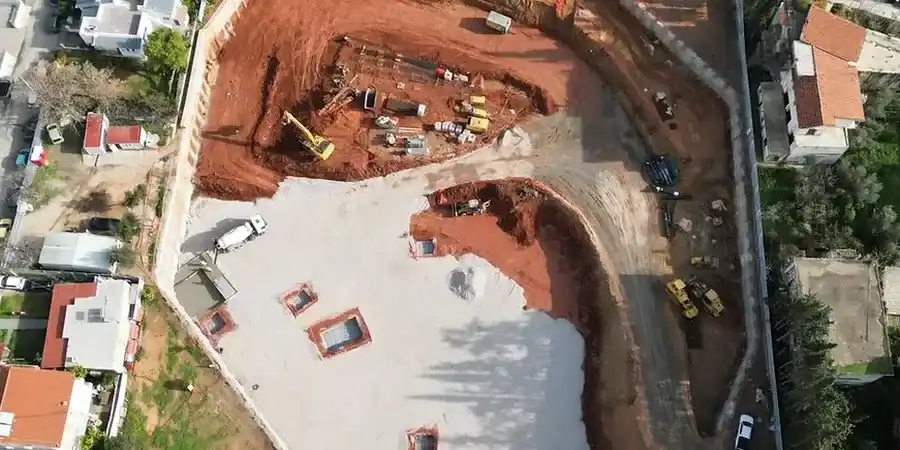
Site-specific factors
Peterborough's city centre expanded rapidly from the 1960s with the Development Corporation. That era left a legacy of buried foundations, old basements, and backfilled brick pits from the brickmaking industry that exploited the Oxford Clay. A deep excavation today can encounter uncharted obstructions or zones of very soft fill where a former clay pit was backfilled with unengineered material. The risk is a sudden loss of bentonite support during diaphragm wall panel excavation, or differential settlement behind a propped wall. We mitigate this with a desktop study of historical Ordnance Survey sheets first, followed by targeted test pits at the perimeter to physically expose the shallow stratigraphy. Base heave is the other critical failure mode in clay. We calculate the factor of safety against hydraulic uplift using the measured piezometric surface from standpipe readings and the total overburden weight at formation level.
Watch how it works
Regulatory framework
BS EN 1997-1:2004 (Eurocode 7: Geotechnical design), BS EN 1997-2:2007 (Ground investigation and testing), BS 5930:2015+A1:2020 (Code of practice for ground investigations), CIRIA C760 (Guidance on embedded retaining wall design)
Linked services
Laboratory Testing Programme
We design the testing schedule to Eurocode 7 standards. Multi-stage triaxial tests on Oxford Clay specimens, oedometer consolidation tests for settlement prediction, and chemical analysis of groundwater for aggressive exposure classes all run in our UKAS-accredited facility.
Retaining System Analysis
We produce the detailed calculation package for embedded retaining walls, propped or anchored. Wall sections, toe embedment depth, waling forces, and base stability checks are all delivered in a format ready for the CAT III checker's review.
Typical parameters
Q&A
How do you determine the earth pressure coefficients for a deep excavation in Peterborough?
We derive them from the effective stress parameters measured in the laboratory. For the Oxford Clay, we use the drained friction angle from triaxial testing and apply the appropriate wall friction value per CIRIA C760. In the short term, undrained parameters control the design and we check both conditions.
What is the typical cost range for geotechnical design of a deep excavation in Peterborough?
The design fee typically falls between £1,430 and £7,620 depending on the excavation depth, number of retained sides, and the complexity of the groundwater control system required for the site's position relative to the River Nene.
How do you handle groundwater in Peterborough's river terrace deposits?
We install standpipe piezometers early in the investigation phase to monitor the seasonal response. If the formation level is within the gravels, we design a dewatering system or a cut-off wall keyed into the Oxford Clay. The permeability contrast between the two units dictates the approach.
Why is base stability a critical check for deep excavations in Oxford Clay?
The Oxford Clay in Peterborough is fissured and its mass undrained shear strength is lower than intact lab values suggest. We calculate the factor of safety against basal heave using Bjerrum and Eide's method, and confirm it with a finite element analysis if the excavation is deeper than 6 metres.