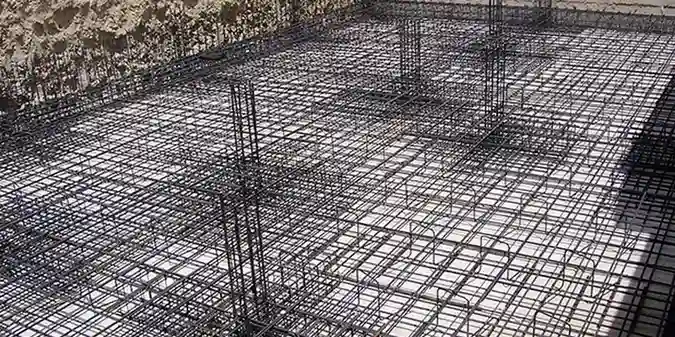
With over 215,000 residents and sitting just 12 metres above sea level, Peterborough faces some of the most variable ground conditions in eastern England. The city’s expansion across former brick pits, river terraces, and the deep fenland peats east of the A1 means bearing pressures are rarely straightforward. A properly configured raft foundation distributes structural loads across a wide footprint, bypassing the need for deep piles in marginal soils. The approach works where isolated plate load testing reveals patchy stiffness, or where CPT data shows compressible layers within the first few metres. Our team sizes each slab using Eurocode 7 limit state principles, adjusting thickness and reinforcement to match the specific stratigraphy encountered on site.
In Peterborough's fen-edge soils, a well-proportioned raft foundation transforms a marginal site into a buildable one without resorting to deep piling.
Our approach and scope
Site-specific factors
A tracked CPT rig or a window sampler mounted on a compact crawler is the first piece of equipment on a Peterborough raft foundation job. The kit must access tight back gardens in Millfield and negotiate soft ground near the Nene washes without bogging. Skipping this phase risks underestimating the depth of peat lenses or the thickness of made ground over former clay workings. A raft designed on assumed rather than measured stiffness can tilt within the first two years, cracking partition walls and jamming doors. The cost of remedial underpinning far exceeds the outlay for a thorough site investigation. We insist on at least two boreholes or CPT soundings per plot, positioned to capture the lateral variation that defines so much of the city's subsoil.
Regulatory framework
BS EN 1997-1:2004 – Geotechnical design (Eurocode 7), BS EN 1997-2:2007 – Ground investigation and testing, BS 5930:2015+A1:2020 – Code of practice for ground investigations, BS EN 1992-1-1:2004 – Design of concrete structures, BS 8004:2015 – Code of practice for foundations
Linked services
Settlement analysis and FE modelling
We use finite element software to predict total and differential settlement under characteristic load combinations, checking against EC7 serviceability limits for the specific soil profile found on site.
Ground investigation specification
We define the scope of boreholes, CPT soundings, and sampling intervals required to satisfy BS 5930 and offer the parameters needed for a reliable raft foundation design.
Construction-phase verification
Site visits during excavation to confirm ground conditions match the design assumptions, including proof rolling of the formation and inspection of any imported granular fill layers.
Typical parameters
Q&A
What does a raft foundation design cost for a typical Peterborough house extension?
For a single-storey rear extension or a new detached dwelling, the design fee typically falls between £890 and £3,240, depending on the complexity of the ground profile, the number of boreholes required, and whether finite element modelling is needed to assess differential settlement.
When is a raft foundation a better choice than strip footings in Peterborough?
A raft makes sense where the near-surface bearing capacity is low, such as on the soft alluvium and peat deposits found east of the city centre. It also suits sites with a history of fill, where trenching for deep strip footings becomes impractical or where the groundwater table sits high enough to complicate excavations.
How long does the design process take once the ground investigation data is available?
With a complete factual and interpretative ground investigation report in hand, the raft design and associated structural calculations are typically delivered within 10 to 15 working days, depending on the project's scale and the need for third-party checking.