In Peterborough, the ground rarely tells the full story from a desk study. The Nene Valley cuts through the city, leaving a legacy of river terrace gravels overlying stiff Oxford Clay. That combination is deceptive. Gravel drains well. The clay beneath does not. When you cut into a slope for a new development near the Embankment or a commercial unit off the A1(M), the pore pressure regime changes. We have seen perfectly dry gravel faces slump after heavy winter rain. The water gets trapped at the gravel-clay interface. That is where most failures initiate. A desk-based assessment alone misses this. Our CPT testing in Peterborough routinely identifies perched water tables that conventional borehole logs overlook. These thin, saturated layers control the factor of safety more than any textbook parameter.
A 4-metre cut in weathered Oxford Clay can fail if the toe is unloaded. The fissured fabric means strength drops sharply with strain.
Our approach and scope
Site-specific factors
A cut slope on a commercial plot off Edgerley Drain Road failed three days after a storm in 2021. The contractor had excavated a 5-metre face to install a retaining wall. The design assumed drained parameters for the clay. The problem was a thin lens of silt at mid-height. Water built up behind the face. The silt liquefied locally. The slope collapsed overnight. No one was hurt, but the excavation was lost and the programme slipped by six weeks. The root cause was not the clay strength. It was the drainage path. A slope stability analysis must include transient seepage for these conditions. Steady-state analysis gives the wrong answer. In Peterborough, where the geology is layered and the weather is wet, we run sensitivity checks on perched water levels as standard. Ignoring that scenario is the single biggest risk on site.
Watch how it works
Regulatory framework
BS EN 1997-1:2004 (Eurocode 7: Geotechnical design – General rules), BS EN 1997-2:2007 (Eurocode 7: Ground investigation and testing), BS 5930:2015 (Code of practice for ground investigations), BS 8002:2015 (Code of practice for earth retaining structures), CIRIA C760 (Guidance on embedded retaining wall design)
Linked services
Field Investigation and Sampling
Rotary and window sampling boreholes to recover undisturbed samples from the Oxford Clay and overlying gravels. Inclinometers and piezometers installed to measure groundwater response through the seasons.
Laboratory Strength Testing
Multi-stage shear box tests and ring shear tests to define peak and residual strength envelopes. Tests run at natural moisture content and after saturation to capture the full strength range.
Limit Equilibrium Modelling
2D slope models using Spencer and Morgenstern-Price methods. Analysis covers drained, undrained, and transient seepage conditions. Back-analysis of existing slopes used to calibrate parameters.
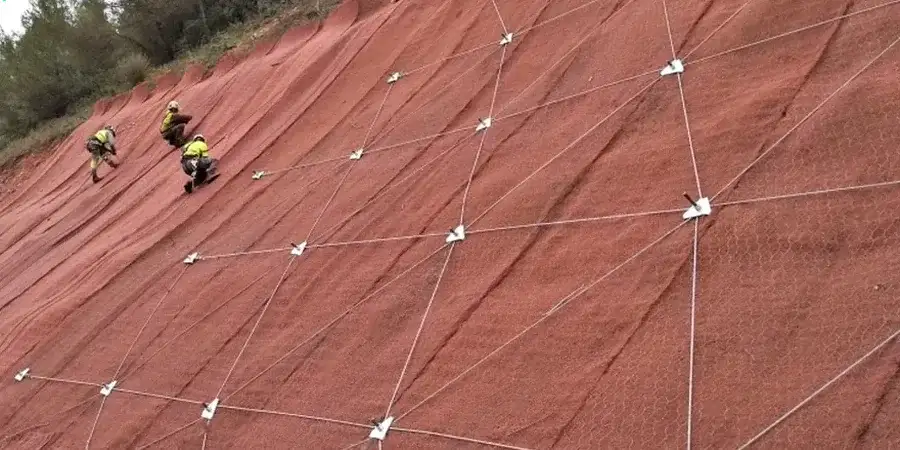
Remediation and Monitoring Design
Design of drainage measures, toe berms, soil nails, and retaining structures. Long-term monitoring plans with trigger levels for movement and pore pressure, aligned with CIRIA C760 guidance.
Typical parameters
Q&A
What soil parameters are used for Oxford Clay in Peterborough?
Oxford Clay is a stiff, overconsolidated, fissured clay. The key parameter is the residual friction angle (φ'r), typically 12° to 16°, because failure surfaces often follow pre-existing fissures. Peak strength is higher but unreliable for long-term stability. We determine both values through multi-stage shear box and ring shear tests on undisturbed samples.
How much does a slope stability analysis cost in Peterborough?
The fee depends on the slope height, site access, and investigation scope. A typical project with two boreholes, laboratory testing, and a limit equilibrium analysis ranges from £880 to £3,800. Complex sites with deep rotational failures or instrumentation require a higher budget.
How long does a slope stability assessment take?
Fieldwork takes 2 to 5 days depending on access and number of boreholes. Laboratory testing adds 10 to 15 working days. The analysis and reporting phase typically takes 7 to 10 working days after receiving lab data. Overall plan for 4 to 6 weeks from instruction to final report.
Which design approach from BS EN 1997 do you use?
We apply Design Approach 1 (DA1) with both Combination 1 and Combination 2. Combination 1 applies partial factors to actions. Combination 2 factors the soil strength. The critical case governs the design. For temporary works we also check against BS 8002 recommendations.
Do you install inclinometers and piezometers in Peterborough?
Yes. We install standpipe and vibrating wire piezometers in boreholes to monitor groundwater levels, and inclinometer casings to track lateral movement over time. Monitoring is essential for slopes where the failure mechanism is not fully understood or where construction proceeds in stages.