In Peterborough, we consistently see that the difference between a pavement that withstands decades of A-road traffic and one that fails after two winters comes down to compaction. The city's rapid expansion—growing faster than any other UK urban area, with over 200,000 residents now—means earthworks are everywhere: from the Great Haddon and Paston Reserve developments to industrial warehousing along the A1 corridor. What catches many contractors off guard is how the Oxford Clay Formation behaves under compaction. It can hold moisture stubbornly, and if you are not checking density properly at each lift, you will get differential settlement later. We run the sand cone test because it is direct, it does not rely on nuclear sources, and when performed to BS 1377-9, it gives you a density value you can defend to any resident engineer. For deeper formation assessment prior to earthworks, we often combine this with test pits to log the clay weathering profile and plan moisture conditioning strategies before a single roller hits the fill.
You can run a roller all day, but without a sand cone test, you are guessing whether the fill will hold—especially on Peterborough's Oxford Clay.
Our approach and scope
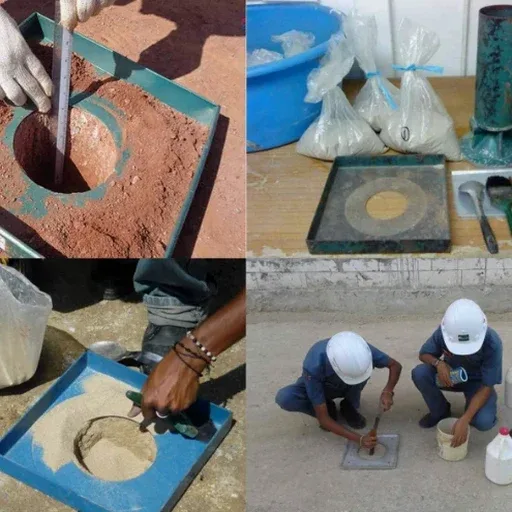
Site-specific factors
BS 5930 and Eurocode 7 (BS EN 1997-2:2007) require that fill be verified as suitable and properly placed—and in Peterborough, the risk of skipping field density tests is amplified by the geology. The Oxford Clay is a highly plastic, overconsolidated material that swells and shrinks with moisture changes. If you import granular fill and place it over unprepared clay without verifying compaction at each lift, you create a perched water trap that softens the clay and leads to shear failure under load. We have investigated failed car park pavements in Peterborough where the root cause was not the asphalt thickness but the underlying fill placed at 85% relative compaction during wet weather. The sand cone method, done at the right frequency and documented properly, is your evidence that the earthworks conform to the Specification for Highway Works—and that you will not be back in two years cutting out failed sections. This is not about ticking a box; it is about matching the test location to the geology and understanding what a 97% versus a 92% result actually means for long-term performance on these soils.
Watch how it works
Regulatory framework
BS 1377-9:1990 – Methods of test for soils for civil engineering purposes: in-situ tests (sand replacement method), BS EN 1997-2:2007 (Eurocode 7) – Geotechnical design: Ground investigation and testing, Manual of Contract Documents for Highway Works – Volume 1: Specification for Highway Works (Series 600 – Earthworks), BS 5930:2015+A1:2024 – Code of practice for ground investigations
Linked services
Compaction Verification Testing
Sand cone density tests at specified grid intervals per compacted lift, with immediate feedback on relative compaction and moisture condition. We calibrate our sand to BS 1377-9 tolerances and can adapt the test layout to irregular fill footprints common on brownfield sites in Peterborough.
Laboratory Compaction Reference (Proctor Curves)
Before we test in the field, we need the laboratory maximum dry density and optimum moisture content for your specific fill material. We run 2.5 kg or 4.5 kg rammer Proctor tests per BS 1377-4, including on Oxford Clay reworked as engineered fill, so field results are compared against a defensible reference.
Earthworks Compliance Reporting
We compile test location plans, density results tables, and moisture content logs into a clear compliance report aligned with Series 600 requirements. This gives the site agent, designer, and adopting authority—typically Peterborough City Council or the local highways team—a traceable record of fill acceptance.
Typical parameters
Q&A
How much does a field density test using the sand cone method cost in Peterborough?
For a single sand cone density test on a Peterborough site, you are typically looking at £70 to £110 per point, depending on access, the number of tests in a day, and whether we are also handling the laboratory Proctor reference. A day rate with multiple points spread across lifts brings the per-test cost down. We quote based on the site location—getting to sites around the Ortons or Hampton is straightforward, while rural access out toward the fen edge can add a bit of travel time.
How many sand cone tests do I need per compacted lift?
The Specification for Highway Works (Series 600, clause 601) suggests a frequency of one test per 500 m² of each compacted layer, but that is a starting point. On a Peterborough industrial unit pad with uniform granular fill, that grid works fine. On a more variable site—say, a former brick pit near Fletton where fill composition changes across the footprint—we recommend tightening the grid to one test per 250 m² to catch material variability. The testing frequency should be agreed with the designer and the adopting authority before earthworks start.
Can you test density through granular fill with larger stones?
The sand cone method works best when the maximum particle size does not exceed about 37.5 mm. If your fill contains cobbles or oversized clasts—which we sometimes encounter in recycled crushed concrete fill on Peterborough brownfield sites—the test becomes less reliable because the excavated hole volume is disturbed by large particles. In those cases, we discuss alternative methods such as a larger-scale replacement test or supplementing with plate load tests to assess stiffness rather than density alone.
What relative compaction percentage is required for structural fill in the Peterborough area?
For fill that will support foundations or floor slabs, the typical specification calls for a minimum of 95% relative compaction, meaning the field dry density must reach at least 95% of the laboratory maximum dry density determined by the Proctor test. For general landscape fill away from structures, 90–93% is commonly accepted. Your structural engineer or the NHBC warranty requirements will dictate the exact figure, but on Oxford Clay sites we tend to be conservative and aim for the higher end because of the material's sensitivity to moisture changes.
How does the sand cone method compare to a nuclear density gauge?
Both methods give you a field density figure, but they differ in practicality and regulation. The sand cone test is mechanical—you excavate a small hole, weigh the removed soil, and measure the hole volume with calibrated sand. It is slower than a nuclear gauge but requires no radiation licensing, no source storage, and no operator certification under IRR17. For smaller Peterborough projects or sites near schools and public areas, many contractors prefer the sand cone precisely because there is no nuclear material on site and the method is transparent to any curious resident or council inspector.