When the rig rolls onto a Peterborough site, the first thing the driller notices is the change in the cuttings—stiff Oxford Clay near the city centre gives way to soft fen deposits within half a mile. That transition is exactly why pile foundation design here is never a copy-paste exercise. We run the CPT test in the western expansion areas to catch the peat lenses that mapping alone misses, and combine it with SPT drilling where gravel terraces near the Nene complicate the drive. The laboratory side—triaxial consolidated-undrained tests on Shelby tube samples—gives us the undrained shear strength we need to input into the pile capacity calculations. Without that local stratigraphic feel, a pile designed for the limestone ridge might end up punching through a buried channel full of compressible alluvium just three metres deeper.
In Peterborough, a pile’s capacity is decided not by the strongest layer but by the weakest peat seam the investigation missed.
Our approach and scope
Site-specific factors
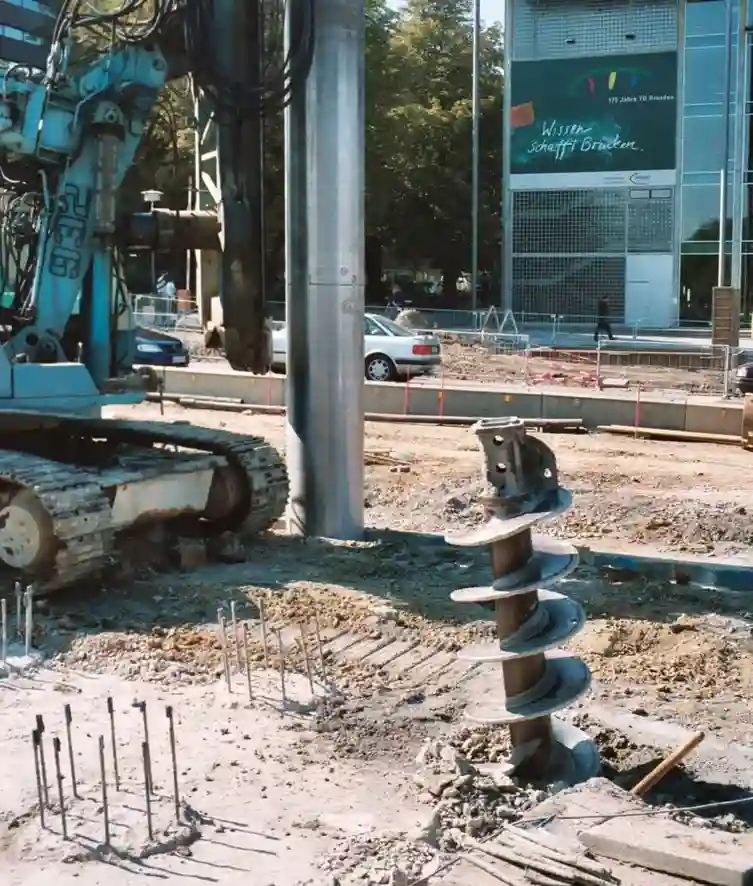
In Peterborough, many times we see bored piles installed through the upper gravels without a temporary casing, and the sidewalls collapse before the concrete goes in. That isn’t just a construction nuisance—it necks the shaft, reduces the sectional area, and turns a 600 mm pile into a variable-diameter column that can’t mobilise the design shaft friction. In the fen-edge clays, the risk shifts to negative skin friction: the peats and soft silts are still consolidating under their own weight, and they drag down on the pile as they settle. We quantify that drag load using oedometer tests on undisturbed samples, then feed the settlement-versus-time curve into the structural design so the pile reinforcement can handle the long-term downdrag without buckling. Ignoring that step leaves a pile that passes the static load test on day one but creeps downward over the following three winters.
Regulatory framework
BS EN 1997-1:2004 Geotechnical design – General rules, BS 8004:2015 Code of practice for foundations, BS 5930:2015 Code of practice for ground investigations, ICE Specification for Piling and Embedded Retaining Walls (SPERW), NHBC Standards Chapter 4.3 – Piled foundations
Linked services
Pile capacity calculation
Static pile capacity analysis for bored and driven piles in the mixed ground conditions typical of Peterborough, using both CPT-based methods and the α-β method from laboratory shear strength data.
Negative skin friction assessment
Oedometer testing on soft fen deposits to estimate the consolidation settlement and downdrag force that the pile will knowledge over its design life.
Pile load test specification and interpretation
We prepare the testing protocol per ICE SPERW and back-analyse the load-settlement curve to calibrate the design parameters, often unlocking a more economical pile length.
Ground investigation for piling
Full site investigation package combining cable percussion boreholes, CPT soundings, and laboratory classification and strength testing, all logged to BS 5930 with AGS4 data delivery.
Typical parameters
Q&A
How much does pile foundation design cost for a residential project in Peterborough?
For a typical single-dwelling project in Peterborough, the combined ground investigation and pile design package falls in the range of £1,240 to £5,320, depending on the number of boreholes or CPTs required and whether the site is in the known fen-edge zone that needs deeper investigation.
What pile type works best in Peterborough’s ground conditions?
It depends entirely on the specific site geology. In the Oxford Clay areas of the city centre, continuous flight auger piles perform well and minimise spoil. In the fen-edge zones with soft peat and alluvium, driven pre-cast piles can be effective because they displace and densify the weak material, but they must be designed with a protective coating against the acidic peat. We make the recommendation after the ground investigation results are in.
Do you need a site investigation before designing the piles?
Yes, it is a mandatory step under BS EN 1997-1. The design bearing resistance of the pile is derived from ground parameters that must be measured, not assumed. In Peterborough, the rapid lateral variation in the drift geology means that two boreholes on opposite corners of a plot can encounter completely different founding conditions, so we always specify at least two investigation points.
How long does the pile design process take from investigation to final report?
A typical programme runs three to four weeks: one week for the field investigation, two weeks for the laboratory testing suite, and one week for the engineering analysis and report preparation. If the project is on a tight timeline, we can split the lab work and release preliminary pile recommendations based on the CPT data within a few days of the fieldwork.