A warehouse extension on Fengate hit refusal at 4 metres—solid limestone below the clay, entirely missed by the desk study. That is the reality of Peterborough’s geology: Oxford Clay overlying Cornbrash limestone lenses, with river gravels along the Nene corridor. The Standard Penetration Test cuts through the guesswork. A split-spoon sampler driven by a 63.5 kg hammer falling 760 mm records the N-value every 1.5 metres, giving us a direct measure of relative density in sands and consistency in clays. On sites near the Embankment, where floodplain alluvium reaches 6 metres thick, we often pair SPT with cone penetration testing when the stratigraphy demands continuous profiling. For shallow foundations on the glacial till that covers much of Hampton, the plate load test provides the bearing capacity validation that BS EN 1997-2 requires alongside the borehole log.
SPT blow counts in Peterborough’s Oxford Clay typically range from 8 to 22 below 3 metres, but refusal on Cornbrash limestone can occur at any depth—plan for it.
Our approach and scope
Site-specific factors
The contrast between two sites just 800 metres apart in Peterborough illustrates the risk. On Thorpe Road, near the river, SPT N-values in the upper 4 metres hover between 3 and 7—soft alluvium requiring deep piles or ground improvement. Move east to higher ground in the city centre, and the same depth interval returns N-values of 15 to 25 in stiff Oxford Clay, suitable for spread footings. Skipping the SPT on a river-terrace site means designing foundations blind. You either over-engineer and waste money, or under-design and face differential settlement. The Cornbrash adds another variable: a site on Fengate might hit rock at 3 metres while a site 200 metres away goes to 15 metres without refusal. Only borehole data resolves this. In Peterborough’s mixed geology, omitting the SPT is not a cost saving—it is a liability that transfers risk directly to the contractor and the structural engineer.
Regulatory framework
BS 5930:2015 + A1:2020 — Code of practice for ground investigations, BS EN ISO 22476-3:2005 + A1:2011 — Standard penetration test, Eurocode 7: BS EN 1997-1:2004 + UK National Annex, BS EN 1997-2:2007 — Ground investigation and testing
Linked services
SPT Boreholes for Foundation Design
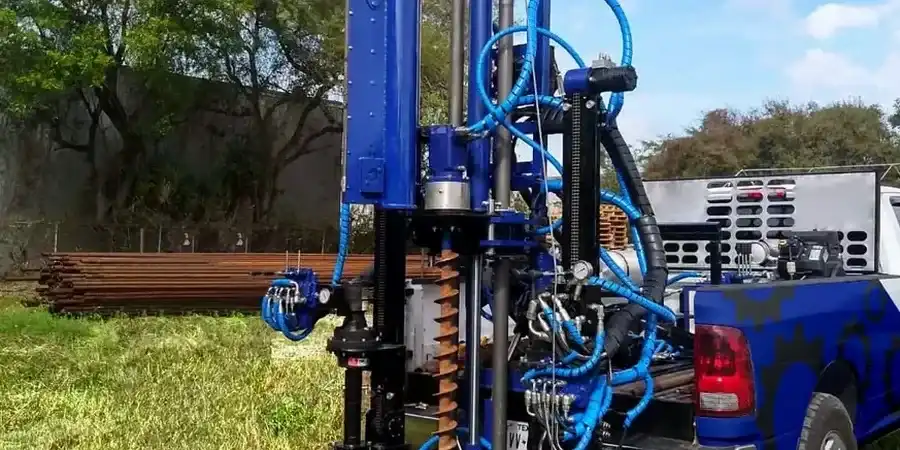
Truck-mounted or tracked rigs accessing sites across Peterborough, from tight urban plots in Millfield to open greenfield sites in Hampton. We log N-values, recover disturbed samples, and install standpipe piezometers where groundwater monitoring is required. Reports include N60 energy-corrected profiles and bearing capacity recommendations aligned with BS EN 1997.
Combined SPT and Laboratory Testing Packages
SPT samples go straight to our UKAS-accredited laboratory for index testing: moisture content, Atterberg limits, and particle size distribution. The combined dataset gives you shear strength parameters for the Oxford Clay and permeability estimates for the river gravels—everything a structural engineer needs to finalise the foundation design.
Typical parameters
Q&A
How much does an SPT borehole cost in Peterborough?
For a single SPT borehole in Peterborough, expect between £410 and £580 depending on depth, access conditions, and whether laboratory testing is included. Sites with difficult access—tight gardens in the Park ward or slopes near the river—may require a smaller tracked rig, which sits at the upper end of that range. We offer a fixed-price quote after reviewing the site location and required depth.
What depth do you typically drill for SPT in Peterborough?
Most residential and commercial projects in Peterborough require 10 to 15 metres. On Oxford Clay sites with no shallow rock, 15 metres is standard. Where the Cornbrash limestone is known to be shallow—areas around Woodston and parts of Fengate—we plan for refusal and log the rockhead depth precisely. For larger structures or where deep piles are anticipated, we extend to 20 or 25 metres to capture the full stratigraphy.
How long does an SPT investigation take from booking to report?
Fieldwork typically takes one to two days for two or three boreholes, depending on depth and ground conditions. Laboratory testing adds five to seven working days. The final interpretive report, including bearing capacity calculations and foundation recommendations, is delivered within two weeks of completing fieldwork. We can fast-track the report for urgent projects.
Is SPT sufficient for foundation design on Peterborough’s clay soils?
Yes, for most structures. SPT N-values correlate well with undrained shear strength in the Oxford Clay, which is the primary parameter for bearing capacity and settlement calculations. Where the clay contains silt partings or the groundwater is high—common near the Nene—we supplement SPT with laboratory triaxial tests on undisturbed samples to confirm the strength profile under drained and undrained conditions.