BS 5930 and Eurocode 7 define the framework for geotechnical design in the UK. In Peterborough, the widespread presence of Oxford Clay makes the triaxial test not just a box-ticking exercise but a critical design tool. We run consolidated drained (CD) and consolidated undrained (CU) triaxial tests to extract effective cohesion (c') and friction angle (φ') parameters. These values are non-negotiable for anyone designing deep excavations or retaining structures in the stiff, overconsolidated clays that dominate the city's geology. A simple shear vane won't give you the effective stress path you need for long-term stability analysis on the Nene Valley slopes. We combine routine triaxial testing with a slope stability assessment to validate cut designs before a single machine moves on site.
Effective strength parameters from a triaxial test are the only way to design a permanent retaining wall in Oxford Clay without relying on conservative, costly assumptions.
Our approach and scope
Site-specific factors
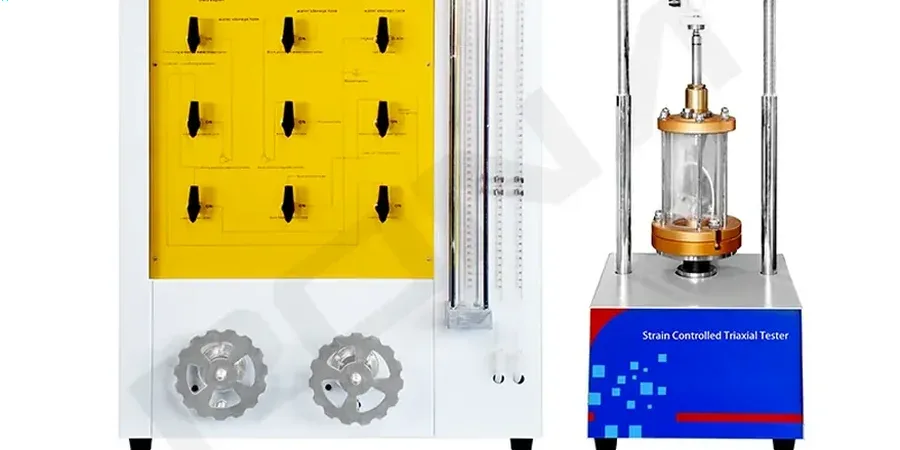
A triaxial cell is a high-pressure vessel that subjects a soil specimen to a controlled radial stress while an axial ram applies the deviator load. Fluctuations in lab temperature or a poor seal on the latex membrane will ruin the test. The biggest risk in Peterborough is sample disturbance. Oxford Clay has a high plasticity index and swells on contact with water. If the Shelby tube is not wax-sealed and shock-absorbed during transport, the soil structure is compromised before the test starts. You end up with a softened specimen, a reduced undrained shear strength, and an unconservative foundation design. We manage this by cutting the specimen inside a humidity-controlled chamber. Another risk is misinterpreting a drained failure envelope for an undrained problem. In the low-lying areas near the Nene, the water table is high, and the short-term stability during construction governs the design. Using the wrong shear strength parameter from a poorly specified test sequence is a direct path to a bearing failure or a trench collapse.
Regulatory framework
BS 1377-7:1990 - Methods of test for soils for civil engineering purposes. Shear strength tests (total stress), BS EN ISO 17892-9:2018 - Geotechnical investigation and testing. Laboratory testing of soil. Consolidated triaxial compression tests on water-saturated soils, Eurocode 7: EN 1997-2:2007 - Ground investigation and testing, UK National Annex to Eurocode 7
Linked services
Consolidated Drained (CD) Triaxial
For long-term stability analysis of cuts, slopes, and permanent retaining walls. We use a slow shearing rate to prevent pore pressure build-up in Oxford Clay, ensuring the measured effective friction angle is reliable for drained conditions.
Consolidated Undrained (CU) with Pore Pressure Measurement
For short-term construction conditions where the rate of loading is faster than the rate of drainage. We record the excess pore pressure to derive the effective stress path (c' and φ') from a single multi-stage test, reducing the number of undisturbed samples needed.
Unconsolidated Undrained (UU) Triaxial
A quick total stress test for assessing the undrained shear strength of cohesive samples directly from the borehole. Useful for checking the consistency of the material before committing to a full CD or CU programme.
Typical parameters
Q&A
How much does a triaxial test cost in Peterborough?
A set of three triaxial tests (one sample at three effective confining pressures) typically falls between £1,550 and £2,290. The exact cost depends on whether you need a CD, CU, or a multi-stage CU test, and how many specimens you require for the project.
How long does it take to get the results back?
A standard consolidated undrained test with pore pressure measurement takes about 7 to 10 working days from sample preparation to the final data sheet. A drained test takes longer, typically 12 to 15 working days, because of the slow shearing rate required to maintain zero excess pore pressure in the specimen. Multi-stage tests can shorten the programme but still need full saturation and consolidation at each stage.
Can you test if the sample has been disturbed during transport?
Yes. We run a saturation check using the back pressure method and measure the Skempton B-value. A B-value below 0.95 indicates incomplete saturation, often caused by sample disturbance or air voids from poor sealing. We log this on the report and note any risk of underestimating the effective stress parameters.