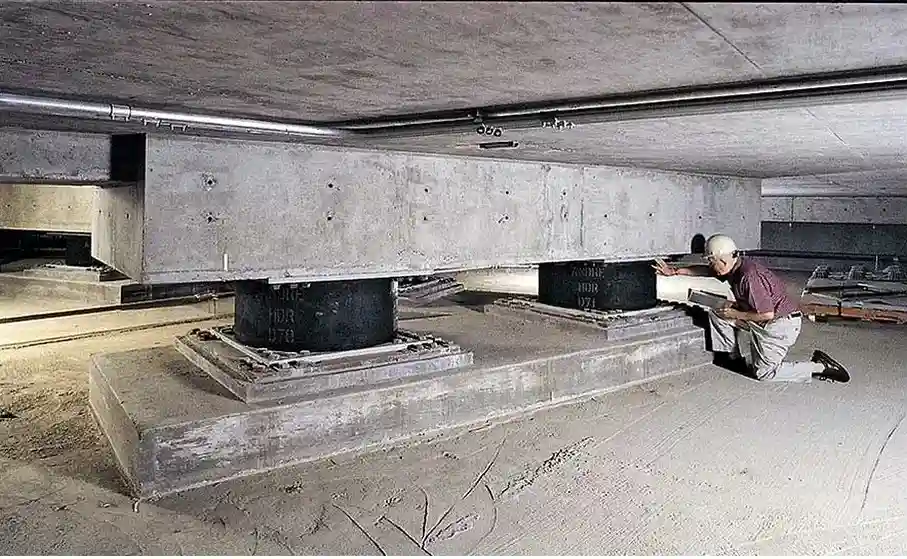
Beneath Peterborough’s expanding urban grid, the Jurassic Oxford Clay Formation and overlying fenland deposits create a specific set of ground conditions that influence every structural decision. With a population approaching 220,000 and major regeneration reshaping the city centre, more developers are encountering compressible clays and high groundwater tables that amplify even modest seismic inputs. BS EN 1998-1:2004 (Eurocode 8) provides the framework, but applying base isolation seismic design here requires detailed site-specific ground motion analysis. The isolation system—whether elastomeric bearings or friction pendulum devices—must be tuned not just to the structure above but to the dynamic response of the clay basin below. Our team runs spectral matching against UK-specific hazard curves to ensure the isolation period sits well clear of the soil’s predominant period, something standard software misses without local borehole data.
Base isolation in soft soil territory like Peterborough is not about the device alone; it is about accurately characterising the ground that feeds the motion into the device.
Our approach and scope
Site-specific factors
On Peterborough’s soft clays, the biggest technical risk is underestimating the long-period spectral displacement. When the Oxford Clay deforms plastically under strong shaking, the effective isolation period can shift, increasing bearing displacement beyond the design envelope. We have seen preliminary models that assumed a rigid base produce isolator strokes that looked comfortable on screen but would bottom out in reality once the compliant soil column was introduced. Soil-structure-isolator interaction is not a refinement here—it is the starting point. Another frequent oversight is ignoring the vertical component of near-field motions on sliding bearings; friction pendulum devices can knowledge momentary uplift that changes the hysteresis loop, and that effect is magnified on sites with a shallow water table. Our design process includes uplift sensitivity checks and, where necessary, hold-down detailing or displacement-restraint rings to keep the isolators in their intended kinematic range.
Regulatory framework
BS EN 1998-1:2004 (Eurocode 8: Design of structures for earthquake resistance), BS EN 15129:2018 (Anti-seismic devices), BS EN 1997-1:2004 (Eurocode 7: Geotechnical design), BS 5930:2015+A1:2020 (Code of practice for ground investigations), UK National Annex to BS EN 1998-1
Linked services
Site-specific seismic hazard assessment
Probabilistic and deterministic hazard curves for the Peterborough site, including soil column amplification from borehole shear wave data.
Isolator selection and NLTH modelling
Comparative analysis of elastomeric and sliding systems using time-history runs matched to the local uniform hazard spectrum.
Peer review and Category 3 checking
Independent design verification aligned with SCOSS recommendations for high-consequence structures.
Typical parameters
Q&A
Is base isolation only for high-rise buildings in Peterborough?
No. While tall buildings benefit, the technology is increasingly used for critical infrastructure, data centres, and heritage structures where operational continuity or damage avoidance justifies the investment. The soft soil profile in the Peterborough area can amplify long-period motion, making isolation attractive even for mid-rise frames.
How long does the base isolation design process take?
A full design cycle—ground investigation, isolator selection, NLTH analysis, and peer review—typically spans eight to twelve weeks. Site-specific ground motion development takes the first three to four weeks, and the non-linear runs and reporting occupy the remainder. Procurement lead times for prototype testing add separately.
What does base isolation design cost for a Peterborough project?
For a typical building project in the Peterborough area, the structural design package for base isolation ranges from £3,220 to £7,350 depending on structural complexity, number of isolator types evaluated, and the extent of peer review required. More info.